Get to Know Asia Live — Billed As the Asian Counterpart to Eataly

Pad Thai meets banh xeo at the new Asia Live.

Last month, a massive new Asian venue opened to great fanfare at Westfield Valley Fair in San Jose, replacing what had been another enormous Chinese restaurant that had debuted with equal excitement.

Asia Live, sister restaurant to San Francisco’s China Live, opened its doors last month, replacing the opulent iChina that operated from 2021 to 2024.

A year and a half in the making, the two-story, 15,000-square-foot Asia Live is an ambitious undertaking not merely for its sheer size, but also because it is located in an upscale shopping mall that already boasts a lot of competition in the Asian cuisine category with such popular restaurants as Marugame Udon, Ramen Nagi, Baekjong Korean BBQ, and Northern California’s only outpost of Din Tai Fung.

But if anyone is up to the challenge, it’s restaurateurs, owners, and husband and wife, George Chen and Cindy Wong-Chen. This is the 17th restaurant that Chen has opened. And it’s not even his largest. That honor goes to China Live at 30,000 square feet, which just celebrated its 9th anniversary.

The second-floor entrance from inside Westfield Valley Fair.
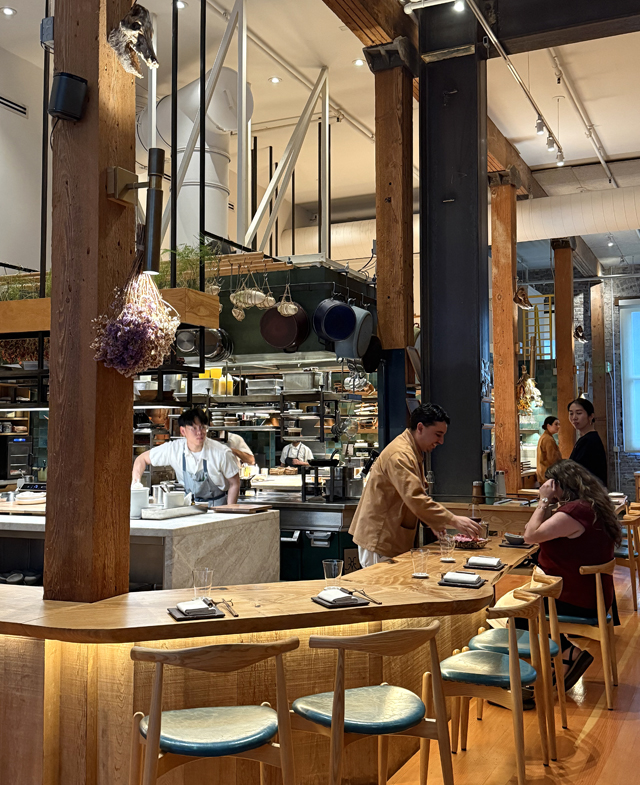
The main dining room on the second floor.
Century-old vintage Chinese posters.

Last week, I was invited in as a guest of the restaurant, where Chen was on hand to show me around — and there is a lot to see.

Read more


Tea Time with Slice-and-Bake Matcha Cookies

Keep a stash of this slice-and-bake dough handy in the freezer and a fresh-baked matcha cookie can be had anytime.

Have we reached peak matcha point yet?

I hope not, because this ancient powdered green tea offers a taste of history, culture, healthfulness, and grassy deliciousness along with its distinctive, vibrant color.

Did you know matcha actually originated in China in the 7th century? A Zen Buddhist monk apparently brought the tea back from his studies in China to Japan, where it was initially prepared by whisking to a froth in hot water in a reverential ceremony.

Nowadays, of course, it can be found in most anything and everything.

I love it in desserts, such as these fragrant “Slice-and-Bake Matcha Cookies.”

This recipe is from “Love Japan” (Ten Speed Press, 2023). The cookbook was written by Sawako Okochi and Aaron Israel, the married couple who are owners of the singular Shalom Japan, a Brooklyn restaurant that melds their respective Japanese and Jewish heritages. It was co-written with New York Times Style writer Gabriella Gershenson.

Read more


Summer Sips

A Sauvignon Blanc that drinks like a Chardonnay.

2023 Larkmead Lillie Napa Valley Estate Sauvignon Blanc

Summer heat may beg for chilled wines. But that doesn’t mean you have to sacrifice oomph and lush body.

Not when you uncork a bottle of the 2023 Larkmead Lillie Napa Valley Estate Sauvignon Blanc, of which I received a sample.

It’s 100 percent Sauvignon Blanc but made in a Bordeaux-style, meaning it’s not only rich tasting but full-bodied.

Fermented in new oak barrels, this isn’t your racy New Zealand-style Sauvignon Blanc with searing acidity. Instead, this is a wine that lushly fragrant with grapefruit and white flowers that tastes of lemon curd, milk bread,, and melon, and boasts a flinty quality. Highly regarded, it’s been described by others as a “Sauvignon Blanc that drinks like a Chardonnay.” Though, thankfully, without being achingly oaky.

Read more

A Visit to N/Soto in Los Angeles

Chicken thigh and chicken meatball skewers at N/Soto -- some of the juiciest chicken I've had in a while.
Chicken thigh and chicken meatball skewers at N/Soto — some of the juiciest chicken I’ve had in a while.

Think of Michelin-starred N/Naka as the older sister in a little black dress and diamonds with a chic persona, while N/Soto is the younger, more carefree sister in t-shirt and jeans — albeit perfectly tailor-made ones.

Both celebrated Los Angeles restaurants are owned and operated by married chefs, Niki Nakayama and Carole Iida-Nakayama. This spring, they celebrated both the 15th anniversary of N/Naka, their high-end, Japanese-meets-Californian kaiseki, and the 4th anniversary of N/Soto, their izakaya.

While “naka” in Japanese means “inside” and is a play on Nakayama’s surname, “soto” means “outside” and references the pandemic when for a time restaurants were forced to shutter, closed off from the outside world.

In fact, N/Soto originated during the pandemic as a pop-up offering to-go bentos. It proved so successful that Nakayama and Iida-Nakayama decided to go all in on a second, more casual restaurant.

Dinner at N/Naka is a 3-hour+ affair that will set you back $395 per person — that is if you can snag one of the hard-to-get reservations. In contrast, while N/Soto does offer a weekday $95 tasting menu, its main menu is strictly a la carte, meaning you can spend as little or as much as your appetite desires.

I’ve had the pleasure of dining at N/Naka twice, including earlier this month, and it remains an exquisite experience. On this particular trip to Los Angeles, I was fortunate enough to be invited in as a guest of N/Soto to try it in comparison.

The entrance to the restaurant.

The front of the restaurant is blanketed in a wall of ivy, with its noren or Japanese fabric divider providing the clue to where the entrance is located.

Read more

Instant Ramen? Instant Yum!

Transform your favorite instant ramen into a version of mac and cheese with spinach.

They say that if you have a pack of ramen, you have a meal.

Well, know what else you have?

A pretty nifty version of mac and cheese in the making, too.

That’s just what “Spinach Ramen Gratin” is like.

It’s from the ingenious cookbook, “Instant Ramen Kitchen” (Chronicle Books, 2025), of which I received a review copy.

It’s by Peter J. Kim, a food entrepreneur who was the founding director of Brooklyn’s now-shuttered Museum of Food and Drink, the former head of creator partnerships at Pinterest, and the former host of Counterjam, Food52’s food and music podcast. He readily admits to eating several bowls of instant ramen each week.

Ramen has a storied history and a fierce following. It was invented in Japan by Momofuku Ando in 1958 in the aftermath of World War II, when he was inspired to create something fast and cheap to nourish his impoverished countrymen.

How beloved is it? As Kim writes in the book, the Fuji Research Institute conducted a poll in 2000 to ask people to name the greatest Japanese invention of the 20th century. The winner, of course, was instant ramen.

Read more
« Older Entries